![]()
All proofs come from the artist's estate. They are beautiful impressions, printed primarily on Japanese mulberry paper.
Floral Drypoints.
Bayonet rush. (jointed bog rush. Juncus militaris). 1932. Drypoint. Jaques 410. 13 3/4 x 4 (sheet 16 3/4 x 8 3/4). A rich impression printed with plate tone on Japanese mulberry paper. Signed in pencil. $300.
Chinese Lanterns. (Physalis alkekengi). 1923. Drypoint. Jaques 337. 9 1/2 x 5 7/8 (sheet 13 x 10 1/4). Printed on the full sheet of Japanese mulberry paper. A fine impression with plate tone. Printed on Japanese mulberry paper, on the full sheet with deckle edges. Provenance: the artist's estate. Unsigned. Annotated "1st". $150.
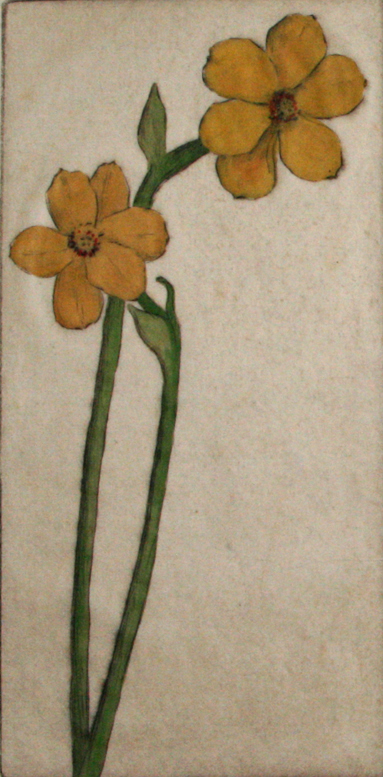
Clematis. (Clematis integrifolia). 1933. Drypoint with hand coloring. Jaques 407. 10 x 5 3/4 (sheet 13 3/8 x 7 7/8). Printed on Japanese mulberry paper. Unsigned. Provenance: the artist's estate. $400.
Columbine. 1931. Drypoint. Jaques 392. 9 3/8 x 4 11/16 (sheet 12 1/2x 8 1/2). A rich impression with plate tone, printed on Japanese mulberry paper. Annotated "1st proof" in pencil. $200.
Dandelions in the Grass. (Taraxacum officinale). 1919. Drypoint. Jaques 278. 13 1/4 x 5 1/4 (sheet 15 7/8 x 5 1/4). A rich impression printed with plate tone in grey-green ink on Japanese mulberry paper. Provenance: the artist's estate. Unsigned. $225.
Darlingtonia. (Darlingtonia Californica) 1934. Jaques 415. 14 x 9 1/4 (sheet 15 3/4 x 10 1/2). A rich impression printed on Japanese mulberry paper. Signed, titled and annotated "Phantom print." $325.
Dogwood Blossoms (Cornus florida). 1924. Drypoint. Jaques 343. 12 3/4 x 8 (sheet 16 1/8 x 10 7/8).Printed on the full sheet of Japanese mulberrypaper. This is probably a ghost or phantom print, a second pulling from the plate before it was reinked. Provenance: the artist's estate. Unsigned. $250.
Eucalyptus Balls (Seeds). February, 1933. Drypoint with hand coloring. Jaques 405. 7 1/2 x 5 5/8 (sheet 10 x 7 1/2). A rich impression printed on Japanese mulberry paper. Signed and titled in pencil. $450.
Fulcassiara (Night Shade #2. Solanum Dulcamara.) 1932. Drypoint with hand coloring. Jaques 432. 10 7/8 x 7 7/8 (sheet 15 1/8 x 10 1/16). A rich impression with plate tone, printed on Japanese mulberry paper. Provenance: the artist's estate. Signed and title in pencil. $750.
Grapes. 1937. Jaques 429. Drypoint. 7 13/16 x 4 7/8 (sheet 10 3/8 x 8 1/16). A rich impression with plate tone, printed on Japanese mulberry paper. Provenance: the artist's estate. $275.
Love Apples. 1939. Drypoint. Jaques 454. 12 3/8 x 7. Two rich impresions on Japanese mulberry paper. Provenance: the artist's estate. Signed and titled in pencil $450; unsigned $250.
Lychee Nuts. (Litchi chinensis). 1938. Drypoint. Jaques 444. 11 7/8 x 8 3/8 (sheet 16 x 10 1/8). A very rich impression printed with plate tone on Japanese mulberry paper. Signed and titled in pencil. $350.
Pearbuds. 1924. Drypoint with hand coloring. Jaques 343. 10 7/8 x 5 7/8 (sheet 15 1/8 x 9 1/2) . Excellent color and condition, printed with plate tone on Japanese mulberry paper. Signed in pencil. $750.
Philodendron (heartleaf). (Philodendron scandens oxycardium). 1935. Drypoint with hand coloring, and a proof without hand coloring. Jaques 416. 9 7/8 x 5 7/8. Both are beautiful impressions printed on Japanese mulberry paper. Unsigned. Provenance: the artist's estate. The frog, lower right, adds a charming touch. $500 the pair.
Plum Blossoms. (Prunus cerasifera). 1937. Drypoint Jaques 423. 12 5/8 x 7 1/4. An extremely rich impression printed in sepia ink on Japanese mulberry paper. Signed and titled "plum" in pencil. $350. Another proof with pale hand coloring. A beautiful impression printed on tissue paper. Signed in pencil. . The pale coloring suggests that this was a second proof from the plate before it was re-inked, or a "phantom print" in Jaques' terminology. $350. Provenance: the artist's estate. $350.
Spiderwort. (Tradescantia bracteata. Bracted Spiderwort). 1926. Drypoint. Jaques 353. 13 7/8 x 7 7/8 (sheet 13 7/8 x 10 1/2). A rich impression with plate tone, printed on Japanese mulberry paper. Provenance: the artist's estate. Unsigned. $250.
Sweetbriar (little). 1922. Etching and drypoint. Jaques 324. 5 7/8 x 2 7/8 (sheet 8 3/16 x 5 3/16). A rich impression with plate tone, printed on Japanese mulberry paper. Provenance: the artist's estate. Monogrammed in the plate; annotated "1st proof" in the artist's hand. The artist also made a larger plate of the same subject. $125.
Sycamore Balls. 1932. Drypoint. Jaques 398. 11 13/16 x 5 7/8 (sheet 15 1/2 x 10).A rich impression with plate tone on Japanese mulberry paper. $400.
Teazel.. 1938. Jaques 447. 14 3/8 x 7 3/8 (sheet 16 x 9 3/4). A very righ impression printed on Japanese mulberry paper. $350.
Walnuts. (Junglans). 1937. Drypoint. Jaques 437. 8 7/8 x 6 3/4 (sheet 14 1/2 x 9 5/8). A very rich impression printed on Japanese mulberry paper. The small dark area, lower left, is a fragment of mulberry paper on the verso. Provenance: the artist's estate. Signed, titled and annotated "1st proof - and a good one too" in pencil. $350.
Wisteria. 1923. Drypoint with hand coloring. Jaques 336. 5 x 3 (sheet 8 1/2 x 6 5/16). A rich impression with plate tone, printed on fine laid paper. Provenance: the artist's estate. Unsigned. $150.
Woodbine. (Parthenocissus quinquefolia). 1937. Drypoint with hand coloring. Jaques 425. 11 x 7 1/4 (sheet 14 1/2 x 10 1/2). Printed on tissue paper. Provenance: the artist's estate. Signed and titled in pencil. This is what Bertha Jaques termed a "ghost" or "phantom" print. It is a second pull from the plate without reinking it. The result is a delicate, ethereal image. $550.
Woodsfolk -- Mushrooms. 1938. Drypoint. Jaques 448. 6 x 8 (sheet 7 5/8 x 9 7/8). A very rich impression with plate tone on cream Rives watermarked paper. Signed and titled in pencil. $325.
Wool Grass. October, 1932. Drypoint. Jaques 399. 13 1/4 x 5 1/2 (sheet 17 3/4 x 12). A rich impression printed with plate tone on white wove paper. Signed and titled in pencil. $300.
Landscape and Architectural Etchings and Drypoints. Signed in pencil.
Click on the images for larger screens.
Dumb Bell Inn -- Near London. 1913. Etching. Jaques 220. 9 13/16 x 5 15/16 (sheet 11 x 8). A rich impression with plate tone, printed on cream wove paper. A rich impression with plate tone. $175.
Hay Shed -- Holland. 1913. Etching. Jaques 219. 9 3/8 x 5 15/16 (sheet 14 x 9 3/8). A fine impression on Japanese mulberry paper. Signed and titled in pencil $175.
Promenade (World's Fair, Chicago). 1897. Not in the Jaques checklist. 5 7/8 x 9 7/8 (sheet 10 11/16 x 17). A fine impression printed in sepia ink with plate tone. Printed on off-white laid paper with full margins. $300.
![]()
Bertha Clausen Jaques was an influential American printmaker in the early twentieth century. She saw an exhibition of the new French etchings at the Chicago Columbian Exposition. Subsequently, she bought a copper plate at the hardware store. She found wax, pitch, and nitric acid. She wrapped a paint roller with leather and located an old dentist's drill. Her physician husband helped her fashion etching equipment from surgical tools. Later, she got a press from Milwaukee. Then, in 1897, she created some of the first etchings in the Midwest.
Jaques collaborated with Helen Hyde while she was in the Orient. Jaques was the author of Concerning Etchings (1912), Country Quest (1936), and Helen Hyde and Her Work, An Appreciation (1922).
She was a founder of the Chicago Society of Etchers , that held its first exhibit at the Chicago Art Institute. The society became the model for other etching societies, making fine prints available to a broad and receptive public. In forty-seven years, the Chicago Society of Etchers exhibited least 40,000 prints across America.
An active printmaker, Bertha Jaques created over 400 etchings and drypoints. None of her works was printed in a large edition. Landscape and botanical images predominate. She experimented with color and technique, applying color by hand, and making counter proofs (which she termed 'ghost prints'). She knew the Latin botanical names of most of the plants, and found beautiful speciments as models. She also used plants to make cyanotypes, and was an early experimenter in the medium.
Bertha Jaques left a creative legacy as mentor, organizer, writer and printmaker.
![]()
To order, to request images, to report broken links or to be placed on the email list, please contact Jane Allinson (allinson@earthlink.net) or send a fax to (860) 429 2825.